
- All
- Product Name
- Product Keyword
- Product Model
- Product Summary
- Product Description
- Multi Field Search
Email: sales@xelitepower.com
 English English
Author: Site Editor Publish Time: 06-16-2026 Origin: Site


Hardware engineers and procurement teams targeting the Australian market frequently face frustrating spatial constraints. Standard wall-mount adapters block adjacent outlets on standard power strips. They also fail to fit behind low-profile digital signage, modern AV setups, or compact lighting fixtures. These bulky legacy shapes cause significant installation friction and lead to messy end-user setups.
You need a reliable power delivery system without compromising tight clearance requirements or risking thermal shutdown. A slim-profile, 12W AC-DC adapter engineered specifically for Australian sockets directly addresses these constraints. It balances compact footprint requirements with stringent thermal management and regional regulatory compliance.
This article provides a vendor-neutral, engineering-focused evaluation framework. We will help you select a compliant, reliable slim power supply. You will learn how to balance form factor requirements with safety standards, ensuring you never sacrifice hardware performance or lifespan in high-density deployments.
Standard bulky adapters cause installation friction; a slim-profile design ensures multi-plug compatibility and fits within low-clearance enclosures.
Compliance is non-negotiable: Deployments in Australia must meet RCM/SAA standards, specifically the unified IEC 62368-1 standard for ITE and AV equipment.
Shrinking the power supply footprint increases thermal density; evaluating burn-in testing and efficiency ratings is critical to preventing premature failure.
Procurement should evaluate vendors based on traceable QA data, custom cable flexibility, and consistent supply chain capabilities.
Modern electronic deployments demand ultra-low clearance hardware. System integrators routinely install smart home hubs, slimline digital signage, and LED lighting arrays in incredibly tight spaces. Legacy adapter shapes fail in these environments. They protrude too far from the wall. They prevent screens from sitting flush against mounting brackets. They force installers to use unsightly extension cords or hollow out wall cavities.
The "adjacent outlet" problem further complicates Australian deployments. Standard AU power boards feature uniquely angled Type I sockets arranged in tight rows. Traditional rectangular adapters easily block neighboring sockets. This frustrates end-users. It also forces deployment teams to specify larger, more expensive power strips just to accommodate a few devices.
Specifying a 12W AU Slim Wall-Mount AC-DC Power Supply provides a direct strategic fit. It solves form-factor constraints immediately. You avoid designing complex, custom internal power supplies for your devices. A slim wall-mount unit moves the heat and bulk outside your product enclosure. It streamlines your own product design while ensuring users can fully utilize their existing power boards without interference.
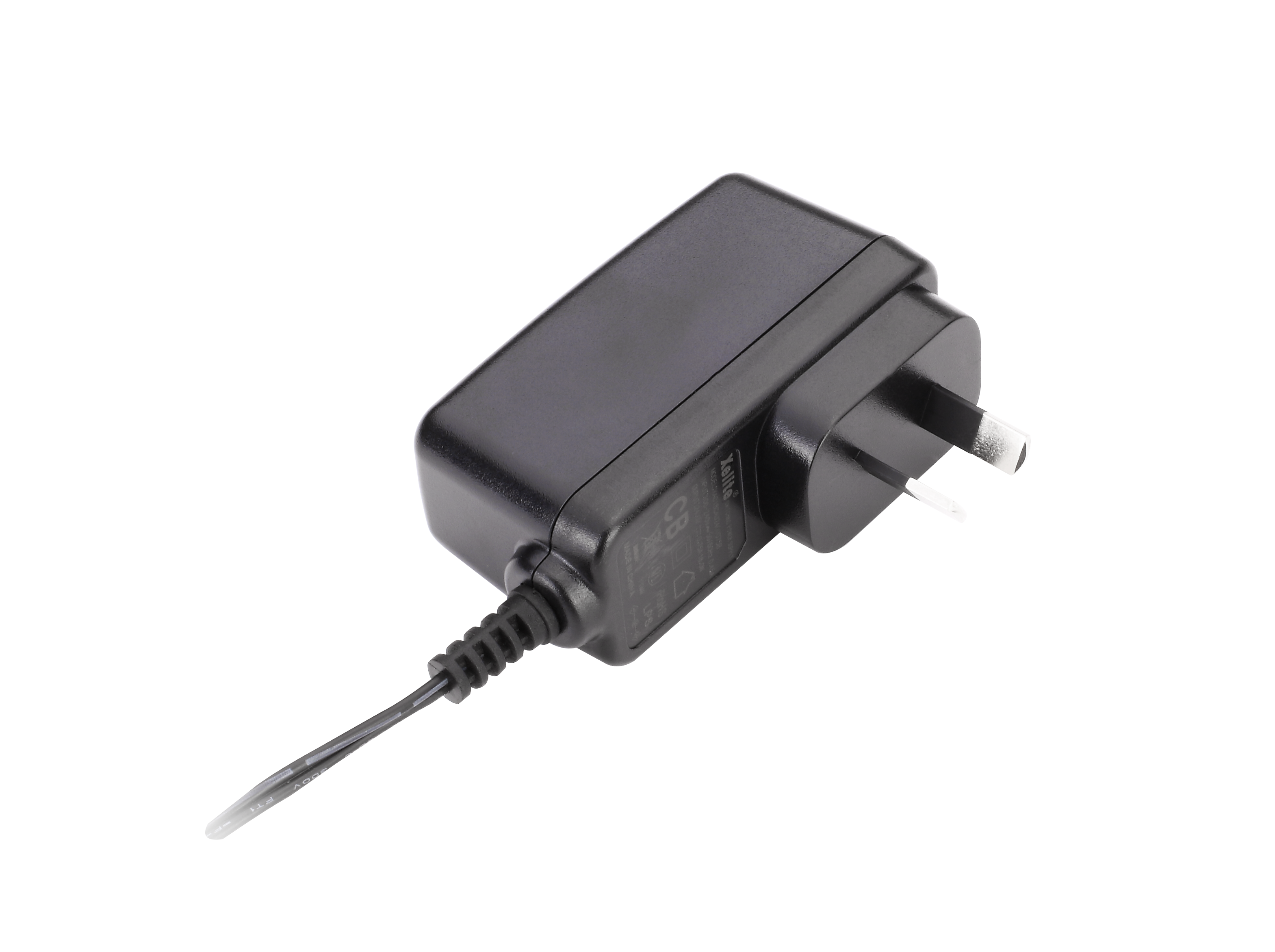
Evaluating a compact power adapter requires looking beyond basic voltage and current ratings. Shrinking the physical footprint heavily impacts internal component stress. Engineers must rigorously assess electrical, thermal, and mechanical parameters.
Energy efficiency dictates thermal performance. Your selected power supply must meet strict efficiency thresholds. You should mandate DoE Level VI or CoC Tier 2 compliance. High efficiency minimizes wasted energy. Less wasted energy means less internal heat generation.
Ripple and noise limits are equally crucial. Sensitive AV systems pick up electrical noise easily. This manifests as audible hum in speakers. For lighting applications, excessive ripple causes visible LED flicker. You must verify adapter datasheets for low peak-to-peak ripple voltage, typically seeking values under 120mV for a 12V output.
Reducing physical volume concentrates heat. A slim adapter lacks the internal air gaps found in bulky bricks. Heat dissipation relies entirely on optimal component layout and casing thermal conductivity.
High-grade internal components become mandatory here. Engineers must specify long-life electrolytic capacitors. Capacitor lifespan drops by half for every 10°C rise in operating temperature. Cheap capacitors in tight housings dry out quickly. This leads to premature power supply failure. Always evaluate the thermal ratings of critical internal parts.
Slim adapters must endure the same physical abuse as standard units. You need to evaluate plug pin retention strength. The internal connections must withstand thousands of insertion cycles without loosening.
Casing material safety is vital. Specify UL94V-0 flame-retardant plastics to prevent fire hazards. Finally, inspect the strain relief on the DC output cable. The junction where the cable exits the slim housing experiences severe bending stress. Robust strain relief prevents wire fraying and short circuits.
Evaluation Parameter | Standard Requirement | Engineering Impact on Slim Adapters |
|---|---|---|
Efficiency Rating | DoE Level VI / CoC Tier 2 | Crucial for reducing heat inside tight enclosures. |
Ripple & Noise | < 1% of Output Voltage | Prevents AV audio interference and LED lighting flicker. |
Plastic Flammability | UL94V-0 | Ensures casing self-extinguishes, critical for unventilated spaces. |
Capacitor Temp Rating | 105°C Minimum | Guarantees long-term stability despite high thermal density. |
Shipping hardware to Australia requires strict regulatory adherence. You cannot rely on generic CE or FCC marks. The Australian market mandates specific regional certifications designed around local grid voltages and safety expectations.
The Regulatory Compliance Mark (RCM) is legally mandatory. Any AC-DC adapter entering the Australian market must carry this logo. It proves compliance with both electrical safety and electromagnetic compatibility (EMC) rules. You must ensure the manufacturer holds a valid certificate and registers the product on the national EESS (Electrical Equipment Safety System) database.
Historically, manufacturers certified ITE under IEC 60950-1 and AV equipment under IEC 60065. The industry has now shifted to IEC 62368-1. This is a unified, hazard-based standard. It simplifies product certification across both categories. A modern slim adapter certified to IEC 62368-1 confidently powers routers, smart displays, and set-top boxes under one unified safety framework.
Lighting applications sometimes require crossover compliance. If your adapter acts directly as LED control gear, it might need compliance with AS/NZS 61347. Always verify these specific claims with your vendor. Ask for the official test reports if your deployment focuses heavily on architectural lighting.
Counterfeit compliance presents massive operational risks. Relying on uncertified hardware invites customs seizures. It also exposes your company to severe legal liability if a product causes property damage. Always request transparent, verifiable compliance documentation directly from the factory before placing mass orders.
Even a perfectly certified power supply can fail if implemented poorly. High-density deployments introduce unique physical and environmental challenges. Engineers must anticipate these variables during the design phase.
Slim adapters often end up inside unventilated customer kiosks. They sit trapped in tight wall cavities behind digital screens. These environments lack ambient airflow. The ambient temperature can quickly exceed 40°C. Heat entrapment forces the adapter to operate near its thermal limits. This degrades components rapidly and triggers protective thermal shutdowns.
Common Mistake: Ignoring ambient temperature ratings in enclosed spaces.
Best Practice: Always design enclosures with passive venting slots or allow a 20% power derating margin for unventilated zones.
Installers often force flush-mounted AV equipment against the wall. This forces the DC cord into sharp bending angles right at the junction. Over time, these extreme bends cause metal fatigue inside the wire. The copper strands break, causing intermittent power loss or dangerous arcing. You must specify appropriate strain relief or right-angle DC connectors to mitigate routing stress.
Operating continuously near the maximum 12W limit exposes cable deficiencies. Voltage drops occur over long DC cables. Thin-gauge copper wire exacerbates this issue. If a device pulls exactly 12W, a cheap, thin cable might drop the voltage from 12V down to 11.2V by the time it reaches the device. This causes unexpected reboots in sensitive ITE equipment. Always match the AWG (American Wire Gauge) thickness to your expected load and cable length.
Procurement teams hold the ultimate responsibility for supply chain reliability. Selecting the right manufacturing partner is as critical as selecting the right hardware specifications. A structured procurement checklist prevents costly manufacturing surprises.
Verifiable QA and Testing: Never accept verbal promises regarding quality. Demand to see factory data. You should request 100% full-load burn-in testing records. Ask the vendor for Mean Time Between Failures (MTBF) calculations based on established standards like MIL-HDBK-217F.
Customization Capabilities: Standard off-the-shelf adapters rarely fit custom projects perfectly. Can the manufacturer modify DC connector types easily? You might need a 5.5x2.1mm plug, or a custom locking barrel to prevent accidental disconnects. Assess their ability to alter cable lengths or incorporate custom branding without demanding massive Minimum Order Quantities (MOQs).
Supply Chain Stability: Hardware rollouts span multiple years. You need long-term availability. Evaluate lead times rigorously. Demand component sourcing transparency. Check if they rely on single-source IC chips that might face shortages. Finally, review their warranty terms to ensure they stand behind their engineering claims.
A slim power supply is never just a simple commodity. It remains a strategic component deeply impacting product safety, user experience, and regulatory liability in the Australian market. By addressing spatial constraints intelligently, you prevent installation headaches and improve the overall aesthetic of your deployments.
Your next steps should focus heavily on the evaluation phase. Start by requesting official compliance certificates for RCM and SAA. Review technical datasheets meticulously, focusing on thermal ratings and efficiency levels. Finally, order engineering samples. Run internal thermal stress tests and full-load validations to ensure the unit performs flawlessly inside your specific hardware enclosures.
A: Historically, separate standards governed them. IEC 60950-1 covered Information Technology Equipment (ITE), while IEC 60065 covered Audio/Video (AV) equipment. The industry has now unified these under the hazard-based IEC 62368-1 standard. Modern certified adapters typically cover both categories simultaneously, simplifying compliance for interconnected smart devices.
A: Not if engineered correctly. High-efficiency designs, such as those meeting DoE Level VI, generate significantly less heat internally. However, they must be deployed properly. You still need adequate ambient ventilation to ensure long-term capacitor health and prevent triggering internal thermal protection circuits.
A: Look for the RCM (Regulatory Compliance Mark) logo printed on the adapter casing. You should then cross-reference the supplier's registration and product certificate on the Australian EESS (Electrical Equipment Safety System) national public database to ensure the certification is authentic and current.
A: Most reputable adapters feature over-current and over-power protection. They can handle brief transient spikes. However, continuous operation above the rated 12W will trigger auto-recovery shutdowns or drastically reduce product lifespan. Engineers should always spec devices with a 15-20% continuous power margin.


