
- All
- Product Name
- Product Keyword
- Product Model
- Product Summary
- Product Description
- Multi Field Search
Email: sales@xelitepower.com
 English English
Author: Site Editor Publish Time: 06-26-2026 Origin: Site


Power supply failures in high-value Information Technology Equipment (ITE) and Audio/Video (AV) systems present massive technical risks. A sudden loss of power ruins expensive equipment and pauses critical operations. The 150W power threshold serves as a critical juncture for external desktop adapters. At this specific wattage, thermal management, energy efficiency, and strict regulatory compliance directly intersect. Sourcing a reliable 150W Desktop ITE AV C14 AC-DC Power Supply demands careful engineering scrutiny to protect sensitive electronics.
This article provides a rigorous, evidence-based evaluation framework. We will guide engineers and procurement managers through shortlisting high-wattage desktop power supplies safely. You will learn how to verify datasheets, ensure global compliance, and avoid catastrophic system failures. By following these guidelines, your technical team can secure optimal power stability for demanding commercial applications.
Unified Standard Compliance: IEC/EN/UL 62368-1 is non-negotiable for modern ITE and AV applications; verify authentic certification to avoid costly product recalls.
Thermal and Efficiency Demands: At 150W, DoE Level VI efficiency is critical not just for regulatory compliance, but for eliminating the need for active cooling (fans) and improving MTBF.
Global Scalability: The IEC 320 C14 AC inlet allows for worldwide deployment using localized, easily sourced standard power cords while ensuring proper earth grounding.
Datasheet Verification: Evaluate power supplies based on verifiable derating curves and real-world operating temperature specs, rather than peak "best-case" claims.
Information Technology Equipment requires precise energy regulation. Poor power delivery triggers rapid data corruption. Unstable voltages cause unexpected system reboots. Sensitive AV equipment faces equally severe threats from inconsistent power. Dirty power introduces severe audio hums. Voltage drops create noticeable video artifacts during live broadcasts. Thermal throttling inside a subpar adapter causes intermittent power drops. These fluctuations degrade signal integrity. They ultimately damage sensitive internal processing components.
Regulatory landscapes mandate safer equipment designs. The industry recently shifted away from legacy safety standards. IEC 60950-1 and IEC 60065 no longer govern modern electronics. They have been replaced by the hazard-based safety engineering of IEC 62368-1. This modern framework forces manufacturers to classify energy sources strictly. It demands built-in safeguards to protect users from electrical hazards. Compliance is mandatory for legal market entry.
Desktop form factor realities dictate external power processing. Processing a 150W continuous load generates substantial internal heat. Keeping this power processing unit inside the main equipment chassis complicates thermal design. It requires bulky internal heatsinks. Moving the 150W load outside simplifies internal architecture. It removes a major heat source from sensitive microprocessors. External adapters also accelerate end-product safety approvals. They carry their own independent safety certifications.
Hardware manufacturers need streamlined supply chains. The standard IEC 320 C14 inlet allows OEMs to stock one universal base power supply. You simply pair it with region-specific C13 line cords. This standardization eliminates the need for separate regional adapter models. It massively simplifies global inventory tracking. You can ship the exact same power unit to Europe, Asia, or North America safely.
Electrical safety requires robust earth grounding. The 3-pin C14 configuration provides this critical grounding connection. Commercial AV and ITE setups depend on strong grounds. Grounding reduces hazardous touch currents. It protects operators during physical interactions. A solid ground also dramatically improves EMI performance. It bleeds off stray electrical noise. This creates a silent background for high-end audio amplification.
Physical durability matters in commercial environments. We must contrast the mechanical retention of the C14 inlet against smaller alternatives. Connectors like the C6 or C8 offer less physical grip. The C14 inlet securely locks the standard power cord in place. It carries higher current capacities continuously without overheating. A 150W continuous load requires sturdy physical connections to prevent accidental unplugging and dangerous electrical arcing.
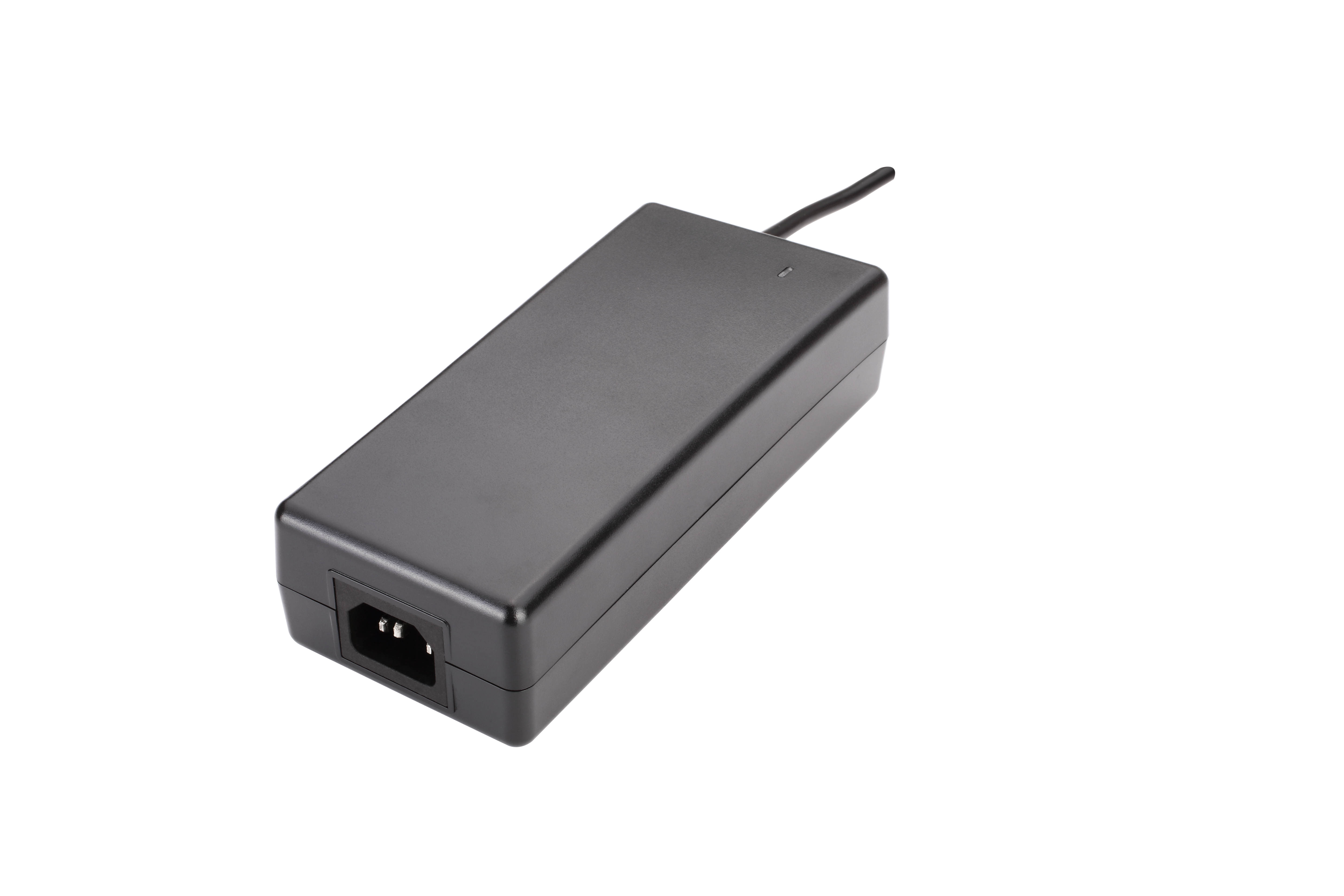
Minor efficiency drops create massive heat at high wattages. We must understand the underlying math at 150W. A unit operating at 89% efficiency traps significantly more heat than a 94% efficient unit. All waste heat stays trapped inside a sealed plastic desktop enclosure. Excessive trapped heat destroys internal capacitors prematurely. The table below illustrates this critical thermal difference clearly.
Efficiency Level | Total Output Power | Waste Heat Dissipated | Thermal Cooling Impact |
|---|---|---|---|
89% (Older Standards) | 150W | ~18.5W | Requires internal fans or massive heatsinks |
94% (DoE Level VI) | 150W | ~9.6W | Supports completely passive fanless operation |
Thermal risk mitigation is essential for professional applications. Strict convection-cooled (fanless) operation eliminates vulnerable moving parts. Fans accumulate dust over time. They eventually fail mechanically. A fanless design prevents catastrophic overheating caused by fan failure. It also eliminates acoustic noise entirely. Absolute silence is vital for high-end AV installations.
Electromagnetic interference ruins system performance. You must demand stringent EMI/EMC compliance. The adapter must meet FCC Part 15 and EN55032 Class B limits. Uncontrolled emissions interfere with sensitive audio and video signals. Class B compliance ensures the power supply operates quietly. It prevents the adapter from radiating disruptive electromagnetic waves across the room.
Human interaction demands strict safety thresholds. Acceptable leakage current maximums protect operators safely. ITE and AV equipment often sit on desks or near human operators. You touch these devices frequently. High leakage currents cause noticeable electrical shocks. The 150W Desktop ITE AV C14 AC-DC Power Supply manages leakage to sub-milliamp levels.
Dynamic operations require exceptional transient response. Processors in ITE equipment spike unexpectedly during complex calculations. Amplifiers in AV systems draw massive power bursts during loud audio segments. The adapter must maintain tight voltage regulation under these sudden load steps. High-quality units hold voltage regulation to a strict ±5% margin.
Integrated electrical protections are non-negotiable for system survival. Modern power supplies must feature automated fail-safes. These circuits protect the load device from grid anomalies.
Over Voltage Protection (OVP): Shuts down the output instantly during dangerous voltage spikes.
Over Current Protection (OCP): Limits excessive current flow to prevent circuit overloading.
Short Circuit Protection (SCP): Isolates the power circuit completely during a physical short.
Over Temperature Protection (OTP): Disables power processing before internal heat causes structural damage.
Datasheets often hide critical thermal limitations. Buyers must demand transparent thermal derating data. Manufacturers frequently rate a supply for 150W at an ideal 40°C. If ambient temperatures rise to 50°C, the supply might only output 100W safely. Ignoring these derating curves causes catastrophic field failures. Always match derating specifications against your actual deployment environment.
Component quality dictates total system longevity. Premium internal components extend the Mean Time Between Failures (MTBF). Cheap components degrade rapidly under heavy loads. Look for high-grade 105°C rated electrolytic capacitors. These superior capacitors resist internal drying. They push the MTBF rating well past 100,000 hours of continuous operation.
Manufacturing validation processes separate premium brands from generic suppliers. Advise your procurement teams to verify factory testing protocols. A reliable manufacturer conducts 100% full-load burn-in testing. They run every unit at maximum capacity inside a heated chamber before shipment. This rigorous step eliminates infant mortality issues.
Engineers must follow a rigid shortlisting framework. Skipping these steps exposes the final product to compliance failures. Use this logic to evaluate any high-wattage desktop power supply.
Application Matching: Verify exact voltage and current requirements first. High-demand hardware needs precise voltage rails like 12V, 24V, or 48V. Ensure the current rating accurately matches the 150W total capacity.
Certification Audit: Demand direct access to valid UL, TUV, or CB certificates. Ensure the paperwork lists IEC 62368-1 compliance specifically. Never accept vague "designed to meet" language on official documentation.
Sample Evaluation: Request physical engineering samples early. Perform extensive in-house integration testing immediately. Focus your tests on thermal behavior and EMI emissions under actual system loads.
Integration testing reveals hidden flaws. Paper specifications cannot replace real-world validation. Your specific internal circuitry interacts uniquely under different power delivery states.
Sourcing a 150W desktop adapter is a critical engineering decision. This single component dictates the safety and reliability of your final product. Poor power delivery compromises system integrity and nullifies internal engineering efforts. High-performance electronics demand flawlessly regulated energy.
Prioritize vendors offering highly transparent datasheets. Choose manufacturing partners providing verifiable safety certifications. Focus on robust global compliance networks. Avoid suppliers competing solely on bare-minimum specifications. Quality power supplies guarantee seamless user experiences.
Consult a specialized power engineer today. Review detailed technical specifications for your next major hardware cycle. Request an evaluation unit immediately. Rigorous upfront testing guarantees a stable and compliant product launch.
A: The primary difference lies in the safety standards. ITE/AV power supplies follow IEC 62368-1. Medical-grade power supplies adhere to IEC 60601-1. Medical supplies require stricter isolation barriers. They feature significantly lower leakage current maximums to protect vulnerable patients.
A: The Department of Energy mandates Level VI efficiency to reduce national energy waste. It is a strict regulatory requirement for external power supplies sold into the US and EU markets. It governs active mode efficiency and strictly limits no-load power consumption.
A: Yes, it can operate completely safely. It must utilize high-efficiency topologies like LLC resonant converters. Manufacturers pair these advanced circuits with proper internal potting and robust passive heatsinking. This effectively dissipates trapped internal heat.
A: Class I electrical equipment requires a mandatory protective earth ground connection. The standard 3-prong C14 inlet provides this physical grounding path. It grounds the metal chassis internally, protecting operators from hazardous electrical shocks.


