
- All
- Product Name
- Product Keyword
- Product Model
- Product Summary
- Product Description
- Multi Field Search
Email: sales@xelitepower.com
 English English
Author: Site Editor Publish Time: 06-12-2026 Origin: Site


For global manufacturers of Information Technology Equipment (ITE) and Audio/Video (AV) hardware, fragmented regional power requirements create massive headaches. They inflate inventory volumes drastically. They complicate logistics pipelines and increase compliance risks significantly.
Managing separate power supply SKUs for North America, Europe, the UK, and Asia-Pacific wastes critical resources. This rigid strategy is no longer cost-effective for mid-wattage devices. Think about hardware like commercial routers, set-top boxes, and smart IoT gateways. Carrying distinct adapters for every single destination market traps your capital in warehouses.
A certified 24W Interchangeable ITE AV AC-DC Power Adapter streamlines global rollouts beautifully. It solves this logistical puzzle by pairing a universal main unit with snap-on regional blades. This modular approach works flawlessly, provided the unit meets strict electrical and mechanical standards. You simplify your supply chain while ensuring reliable power delivery worldwide.
SKU Consolidation: Interchangeable plug designs reduce power supply variants from multiple regional SKUs down to a single global base unit.
Strict AV/ITE Compliance: Standardizing on IEC/EN 62368-1 certification ensures legal market entry across major global jurisdictions.
Energy Efficiency: Modern 24W units must meet DoE Level VI and CoC Tier 2 requirements to prevent regulatory friction.
Reliability Focus: Procurement must prioritize mechanical plug durability and verified safety marks to prevent field failures and liability.
Traditional hardware deployment requires forecasting and stocking fixed-plug adapters based on unpredictable regional sales data. You must estimate demand across the US, EU, UK, and AU separately. Unfortunately, market realities rarely match initial forecasts perfectly. This misalignment leads to frustrating stockouts in one fast-growing region. Simultaneously, it creates dead inventory in another slower market. This imbalance drains working capital.
Shipping one base adapter paired with a modular plug kit changes everything. It shifts your entire inventory management from rigid regional allocation to universal adaptability. Instead of holding four different completed products, you hold one base unit. Warehouse teams simply attach the correct regional blade before boxing the order. Sometimes, manufacturers include all plugs in the box, letting the end-user choose.
While interchangeable adapters carry a slightly higher upfront unit cost than fixed-plug variants, the ROI becomes obvious quickly. The real financial return happens across your operations. You experience massively reduced warehousing costs. You simplify your Bills of Materials (BOMs) dramatically. Furthermore, you achieve faster time-to-market. When an unexpected European order arrives, you do not need to wait weeks for a new batch of EU-plug adapters. You fulfill the order immediately using your universal stock.
Assess your power delivery requirements thoroughly. Evaluating if 24W provides sufficient headroom is your first step. Common configurations output 12V/2A, 24V/1A, or 9V/2.6A. You must ensure this capacity handles peak loads effectively. Devices like AV receivers, IT networking gear, or POS systems often draw surge currents during boot-up sequences. A robust unit handles these spikes without triggering over-current protection protocols.
AV equipment remains highly sensitive to electrical interference. Highlight the necessity of low ripple and noise specifications when selecting a unit. You typically want specifications showing less than 120mVp-p. Excessive electrical noise causes severe problems. It introduces audible hum into audio systems. It also creates visible artifacts on video displays. Clean power delivery protects the premium experience your hardware offers.
Ensure the unit complies strictly with modern efficiency mandates. Regulatory bodies actively block inefficient electronics from entering their markets. Your adapter requires US DoE Level VI certification. For European markets, it needs ErP (Eco-design Directive) and CoC Tier 2 compliance. These rules mandate high active mode efficiency. They also require extremely low no-load power consumption, usually under 0.1W. Failing to meet these standards invites immediate regulatory friction.
Evaluating multi-tip configurations adds immense value to your product ecosystem. Alternatively, you might specify standard barrel dimensions like 5.5 x 2.1mm. Always verify the correct polarity. Matching proprietary ITE and AV inputs prevents customer frustration and accidental hardware damage.
Electrical Parameter | Recommended Specification | Impact on AV/ITE Performance |
|---|---|---|
Output Power Headroom | True 24W Continuous (e.g., 12V/2A) | Prevents device resets during peak processing loads. |
Ripple & Noise | < 120mVp-p | Eliminates audio hiss and video signal degradation. |
No-Load Power | < 0.1W | Ensures compliance with strict global eco-design laws. |
Active Efficiency | DoE Level VI / CoC Tier 2 | Reduces heat generation inside the adapter casing. |
The safety certification landscape recently underwent a massive transformation. You must understand the critical transition from legacy standards to modern requirements. Previously, the industry relied on IEC 60950-1 for IT equipment and IEC 60065 for AV gear. Those are now obsolete. The industry moved to the hazard-based IEC 62368-1 standard. This standard categorizes energy sources and mandates specific safeguards. It is absolutely non-negotiable for modern deployments.
An enterprise-grade 24W Interchangeable ITE AV AC-DC Power Adapter must carry authentic marks. Verifiable marks for target markets prove your compliance legally.
North America: Requires UL/cUL for electrical safety and FCC for electromagnetic interference.
Europe & UK: Demands CE marking, GS certification, and the newer UKCA mark.
Asia-Pacific: Requires PSE for Japan, CCC for China, and RCM for Australia and New Zealand.
Warn your procurement team against the gray market. Uncertified or "fake mark" adapters flood international supply chains. These cheap alternatives pose catastrophic risks. Customs officials actively seize undocumented power supplies at the border. Furthermore, these units cause direct equipment damage due to poor internal isolation. In worst-case scenarios, they trigger product liability lawsuits if they start a fire.
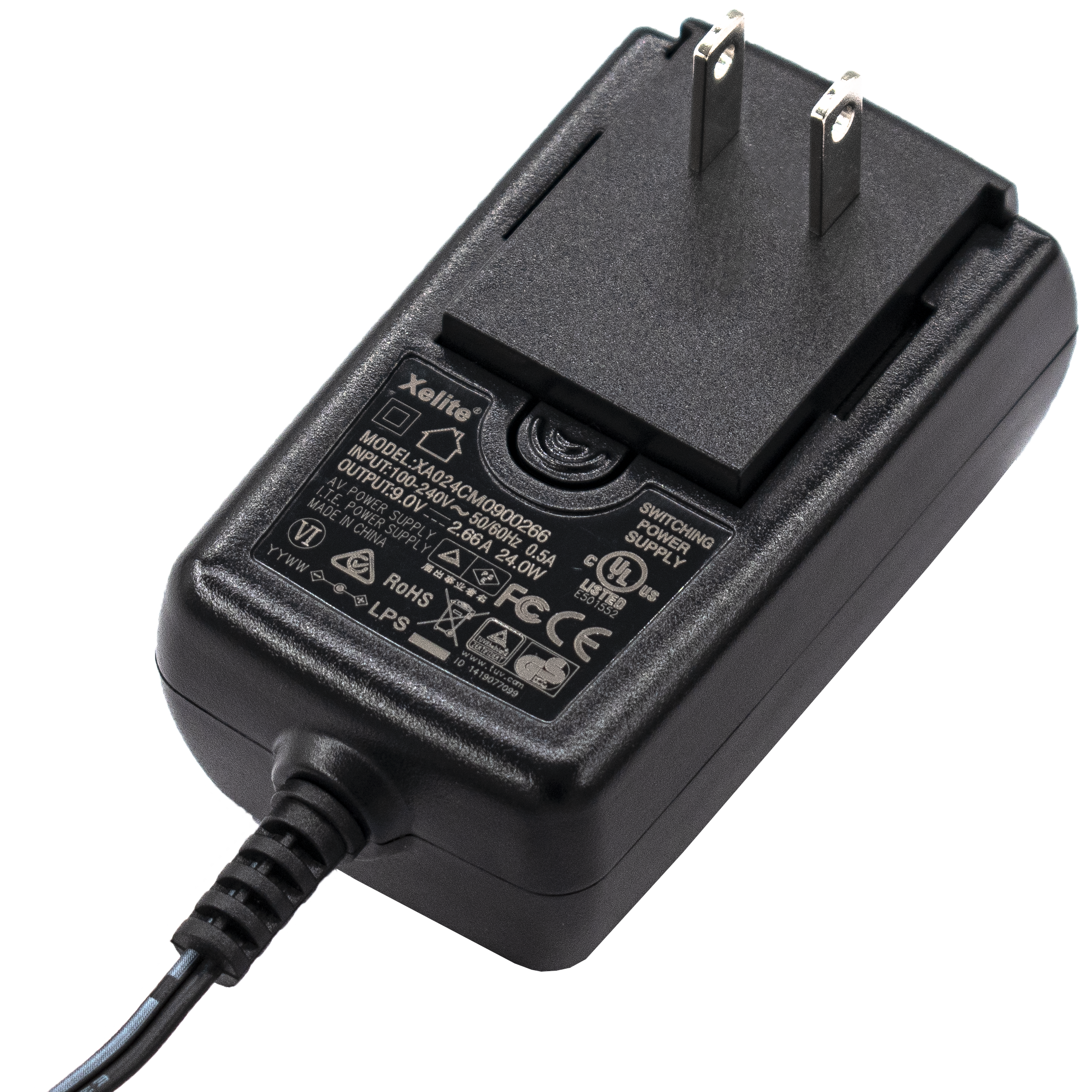
The most common failure point in interchangeable adapters is a flimsy slide-or-click mechanism. Outline strict criteria for robust, vibration-resistant locking designs. Poor mechanisms allow the regional blade to detach accidentally. This interrupts power abruptly and frustrates users. Quality units use high-tension retaining clips. They prevent accidental unseating during heavy daily use.
Look for suppliers who provide hard data on durability and testing. Do not rely on vague promises. Ask for specific insertion and extraction life cycles. A good plug mechanism survives at least 5,000 mating cycles. Request drop test survival records. Analyze the MTBF (Mean Time Between Failures) ratings at varying operating temperatures. Adapters face extreme heat inside network cabinets. They must perform reliably regardless of environmental stress.
Material safety represents another crucial technical barrier. The adapter housing must meet UL94V-0 flame retardant standards. Prolonged continuous operation naturally generates internal heat. If a component fails and arcs, the exterior plastic must self-extinguish immediately. Choosing UL94V-0 plastics helps mitigate severe fire risks associated with continuous 24/7 operation.
Choosing the right manufacturing partner requires rigorous vetting. You need a systematic approach to eliminate unreliable vendors quickly.
Do not accept PDF certificates at face value. Digital documents are notoriously easy to forge or alter. Establish a strict internal protocol to cross-reference UL and CE file numbers. Always use official online safety databases to verify active status. If a supplier hesitates to share their direct test report numbers, walk away immediately.
Assess the manufacturer’s ability to provide custom modifications. Standard units rarely fit every unique hardware project perfectly. Can they provide custom DC cable lengths for specific installation environments? Can they integrate specific EMI/EMC ferrite beads to silence specialized audio gear? Do they allow custom branded labeling? They should offer these services without demanding massive minimum order quantities (MOQs).
Evaluate their overall supply chain resilience. Check realistic lead times during peak manufacturing seasons. Assess their total production capacity. Finally, scrutinize the supplier's process for handling RMA (Return Merchandise Authorization). A transparent RMA process and a low historical defect rate signal a mature, reliable partner.
Verify all safety file numbers directly on the UL or TUV database.
Request engineering samples to test plug locking tension physically.
Confirm the exact MOQ required for customized DC cable lengths.
Review the supplier's documented RMA policy and defect rate history.
Transitioning to a 24W Interchangeable ITE AV AC-DC Power Adapter is a highly strategic move. It successfully aligns logistics efficiency with rigorous global safety standards. You eliminate redundant regional inventory while guaranteeing legal compliance everywhere you ship.
Base your final procurement decision on more than just the lowest per-unit cost. Prioritize mechanical plug durability to prevent user frustration. Insist on verified IEC 62368-1 compliance to avoid legal hurdles. Always reward supplier transparency during the vetting process.
Stop managing dozens of separate power supply variants. Request compliance documentation and engineering samples from qualified manufacturers today. Conduct thorough in-house load testing. Evaluate the mechanical locking mechanisms alongside your specific ITE and AV hardware. This hands-on verification ensures flawless global deployments.
A: Yes, it works perfectly for mid-tier devices like streaming boxes, IP cameras, and network switches. Calculate your device's maximum current draw by multiplying Voltage and Amperage. Ensure you leave a 15-20% safety buffer below the actual 24W limit to prevent overheating during peak processing loads.
A: Always request the official certificate of compliance and the specific test report number from the supplier. Verify this data directly through the testing laboratory's online directory. Reputable labs like UL, TUV, and Intertek maintain public databases to cross-reference file numbers instantly.
A: Poorly designed mechanisms absolutely can fail. However, quality industrial adapters use high-tension locking pins. They undergo rigorous mating-cycle testing. This ensures the plug remains completely secure and wobble-free even over thousands of insertion and extraction uses.
A: Yes. While the wall-side plug remains interchangeable for global regions, you can customize the DC output cable. You can hardwire it to a specific barrel size for security. Alternatively, you can fit it with a multi-tip daisy chain for maximum compatibility across various hardware devices.


