- All
- Product Name
- Product Keyword
- Product Model
- Product Summary
- Product Description
- Multi Field Search
Email: sales@xelitepower.com
 English English
Author: Site Editor Publish Time: 11-29-2025 Origin: Site


Background
In early 2025, a long-term European client approached us with a new requirement for one of their fire-safety products. Their existing control board needed to be redesigned to achieve higher reliability, a more compact footprint, and full compatibility with their upgraded wireless module based on ESP32 + Qorvo DW3000 (UWB module). Since this device would be installed in harsh industrial environments, the customer required a design that was robust, stable, and resistant to electrical noise.
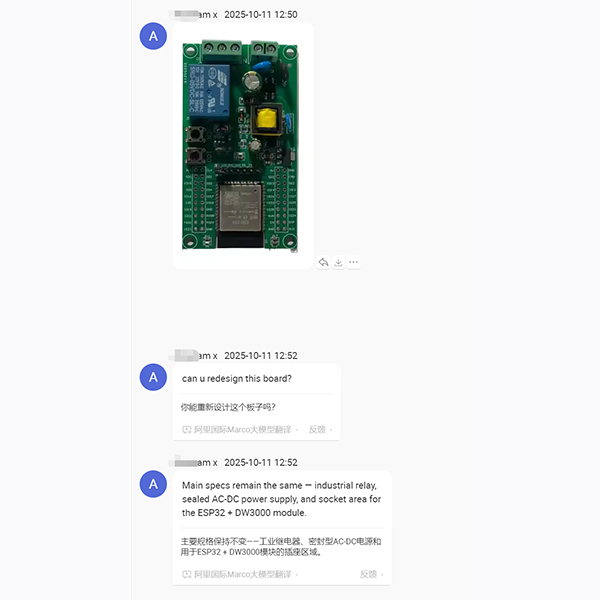
They outlined several key requirements at the initial stage:
Integration of two industrial-grade relays to control external fire-safety actuators.
A sealed AC-DC power module to ensure isolation, durability, and safe long-term operation.
A dedicated socket area for easy installation and replacement of the ESP32 + DW3000 module.
A board layout that was as compact as possible, allowing it to fit into their fire-alarm enclosure without increasing size.
Full compliance with industrial use, including stable operation under temperature variations, vibration, and electromagnetic interference.
Because our team has deep experience in PCB design, power systems, and embedded modules, the client entrusted us to take charge of the entire redesign.
Our Solution
After reviewing their preliminary specifications, our engineering team proposed a new architecture that optimised both performance and reliability.
1. Compact and Efficient Layout
Industrial fire-safety panels usually have limited space, so board size was a critical limitation. We used a multi-layer PCB structure, carefully routing high-current relay traces, low-noise signal lines, and the wireless communication module area. The final layout reduced the customer’s previous board size while improving thermal dissipation and component organisation.
2. Industrial-Grade Relays
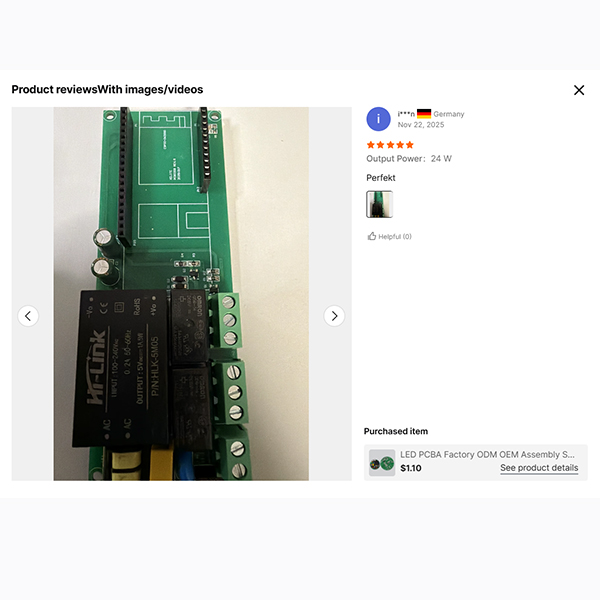
To meet the customer’s actuator-control requirements, we selected two high-reliability relays capable of handling elevated current and voltage demands. The relays were mounted with reinforced clearance and creepage distances to ensure long-term safety and compliance with industrial standards.
We also added:
Snubber circuits for relay protection
Indicator LEDs
Clear labeling for wiring terminals
These design choices made installation and maintenance easier for the customer’s field technicians.
3. Sealed AC-DC Power Module Integration
For the power section, we incorporated a sealed AC-DC module that provides isolation and stable output even under harsh environments. The module selection passed our internal thermal and load-stability tests, ensuring it would operate reliably for thousands of hours.
To enhance protection, we also added:
Input fuse
Surge protection
EMI filtering
Over-voltage and reverse-polarity safeguards
This gave the customer a power block that was both durable and compliant with international safety requirements.
4. ESP32 + DW3000 Socket Area
One of the customer’s goals was modularity. They wanted an easy replacement method for the ESP32 + DW3000 UWB board without the need for soldering. Our team designed a dedicated socket interface, ensuring correct pin alignment, sufficient RF isolation, and stable operation.
The design makes future upgrades or module changes extremely convenient for the customer’s R&D team.
Prototyping, Verification, and Mass Production
We completed the full schematic design, PCB layout, and bill of materials in close communication with the customer. After delivering the initial prototype, the customer conducted functional tests in their fire-safety test facility.
Their feedback was very positive:
Relay operation was stable and responsive.
The AC-DC module generated minimal heat even under stress tests.
The ESP32 + DW3000 module had strong wireless performance and no noticeable EMI issues.
The overall board size was significantly reduced compared to their previous design.
After verification, the customer confirmed mass production.
Project Outcome
We successfully delivered 2,000 pieces of the newly designed board. The production passed our complete QC flow, including:
ICT testing
Functional relay test
High-pot test for power isolation
Burn-in testing
Visual and packaging inspection
The customer expressed strong satisfaction with both the design and production quality. They highlighted that our compact layout, reliable power module integration, and modular ESP32 socket significantly improved their product performance and reduced installation complexity.
Since receiving the shipment, the customer has already integrated the boards into their next batch of fire-safety equipment. They also informed us that they plan to expand this design into their new-generation product line, and we are now discussing follow-up upgrades for wireless communication and added protection features.
Conclusion
This project demonstrated our ability to handle complex, space-constrained industrial designs that combine power electronics, relay control, and wireless communication modules. By working closely with the customer from concept to mass production, we delivered a stable, compact, and reliable solution tailored to the demanding fire-safety market.
If you have similar requirements for customised AC-DC power, relay control, or ESP32-based modules, our engineering team would be happy to support you with professional design and manufacturing services.