
- All
- Product Name
- Product Keyword
- Product Model
- Product Summary
- Product Description
- Multi Field Search
Email: sales@xelitepower.com
 English English
Author: Site Editor Publish Time: 09-07-2025 Origin: Site


In today’s world of advanced healthcare, medical devices and equipment play a central role in saving lives, diagnosing illnesses, and supporting patients in their recovery. Behind the scenes of every reliable medical device is a power source that ensures it operates safely and consistently. One of the most important yet often overlooked components is the desktop medical AC-DC power supply. Without it, many essential healthcare tools would not function effectively or safely.
This article explores why desktop medical AC-DC power supplies are indispensable for modern healthcare equipment. We will discuss how they work, their benefits, the safety standards they must meet, and the role they play in advancing medical technology.
Before diving into their importance, it helps to understand what a desktop medical AC-DC power supply is.
AC (Alternating Current) is the type of electricity supplied by wall outlets.
DC (Direct Current) is the type of electricity required by most electronic devices, including medical equipment.
A desktop medical AC-DC power supply is a device that converts AC power from the outlet into clean, stable DC power that medical equipment can safely use. These power supplies are called “desktop” because they are external units, often placed on or near a desk, counter, or medical workstation, rather than being built into the device itself.
They typically connect to medical devices via cables and offer power outputs designed to meet the strict requirements of healthcare environments.
Medical equipment differs from ordinary consumer electronics in one critical way: human lives depend on them. Whether it’s a patient monitor in an intensive care unit, an ultrasound machine in a diagnostic center, or a ventilator in an operating room, reliable power is not optional—it is vital.
Medical devices require power supplies that provide:
Consistent Voltage and Current: Fluctuations can cause errors or device malfunctions.
Noise-Free Operation: Many medical devices require extremely low electrical noise to avoid interfering with sensitive measurements.
Safety Isolation: Patients are often directly connected to medical equipment, so electrical safety is paramount.
Long-Term Reliability: Devices must function continuously, sometimes for days or weeks, without interruption.
Desktop medical AC-DC power supplies are specifically engineered to meet these demands, making them a key element of modern healthcare infrastructure.
Perhaps the most important benefit is safety. Medical-grade power supplies are designed to meet strict international safety standards such as IEC 60601-1, which defines the electrical safety requirements for medical devices. These standards ensure that:
Leakage currents are kept extremely low, reducing the risk of electric shock.
The power supply provides reinforced insulation and protective barriers.
Devices remain safe to use even under fault conditions.
For example, when a patient is connected to an ECG machine, the electrodes directly touch the skin. Without a properly certified medical power supply, electrical leakage could pose a serious risk. Desktop medical AC-DC power supplies prevent such hazards by maintaining safe isolation between the power source and the patient.
Desktop power supplies are external, which gives healthcare providers flexibility. Instead of designing power circuitry inside each device, manufacturers can rely on a standardized, external supply that connects easily. This makes devices:
More compact: Internal space is freed for functional components.
Easier to service: If the power supply fails, it can be replaced without opening the device.
Portable: A desktop power supply can move with the equipment from one room to another, supporting mobile medical stations, diagnostic carts, or home healthcare devices.
This portability is especially valuable in modern healthcare, where equipment often needs to be mobile to follow patients or adapt to different settings.
Many medical devices rely on highly sensitive electronics. Patient monitors, imaging equipment, and infusion pumps all require precise, stable power to ensure accurate readings and reliable operation.
Desktop medical AC-DC power supplies provide regulated outputs with minimal voltage fluctuation and low ripple noise. This guarantees:
Accurate patient data: Measurements such as heart rate, oxygen saturation, or blood pressure remain trustworthy.
Stable imaging results: Ultrasound or X-ray machines produce clearer, more accurate images.
Dependable performance: Devices run consistently without unexpected shutdowns or errors.
Healthcare facilities often operate in multiple countries or regions. Desktop medical AC-DC power supplies are designed to comply with global safety and efficiency regulations, including:
IEC 60601-1 (Safety Standard)
IEC 60601-1-2 (EMC – Electromagnetic Compatibility)
Energy Efficiency Standards (DOE, ErP, CoC)
This compliance ensures that medical devices can be used internationally without concerns about certification, safety, or regulatory approval. For manufacturers, using certified desktop medical power supplies shortens product development time and reduces the complexity of global distribution.
Compared to integrated power systems, desktop power supplies are more cost-effective to manufacture, maintain, and replace. If a power supply fails, it can be swapped out quickly without servicing the entire medical device. This reduces downtime, which is critical in healthcare environments where equipment availability directly impacts patient care.
Furthermore, the standardization of desktop supplies means healthcare providers can keep spare units on hand for quick replacement, ensuring uninterrupted service.
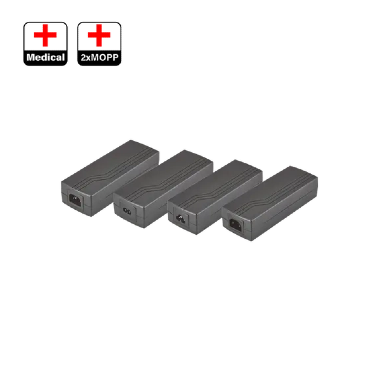
Desktop medical AC-DC power supplies are used across a wide range of medical equipment. Some common applications include:
Patient Monitors – Providing stable power for continuous monitoring of vital signs such as heart rate, blood pressure, and oxygen saturation.
Diagnostic Devices – Powering ultrasound machines, X-ray equipment, and imaging systems that require noise-free, precise power.
Therapy Equipment – Supporting infusion pumps, ventilators, and dialysis machines that must run continuously and reliably.
Home Healthcare Devices – Supplying power for portable oxygen concentrators, CPAP machines, or home diagnostic kits, where safety and portability are equally important.
Laboratory Instruments – Ensuring accurate results in analyzers, centrifuges, and testing devices used in clinical labs.
These examples show how desktop medical power supplies are integrated into nearly every aspect of patient care.
One of the most critical aspects of desktop medical AC-DC power supplies is their adherence to strict safety standards. Without these certifications, medical devices would not be permitted in hospitals or clinics.
IEC/EN/UL 60601-1: Specifies safety requirements for electrical medical equipment, ensuring protection from electrical shock and fire hazards.
IEC 60601-1-2: Focuses on electromagnetic compatibility, ensuring that devices do not interfere with each other.
ISO 13485 (Quality Management): Ensures manufacturing processes for medical equipment follow consistent quality and safety practices.
These certifications assure healthcare providers that the power supplies are safe, reliable, and approved for medical use.
The importance of desktop medical AC-DC power supplies goes beyond safety and reliability. They are enablers of innovation in medical technology.
Support for Portable and Home Devices: As healthcare shifts toward home-based monitoring and treatment, portable devices powered by desktop supplies make care more accessible.
Telemedicine Growth: Reliable power ensures that diagnostic devices used in remote care function correctly, supporting virtual healthcare models.
Advanced Imaging and Robotics: High-performance power supplies support cutting-edge technologies like surgical robots and advanced diagnostic imaging.
In short, these power supplies help push the boundaries of what is possible in modern healthcare, making medical devices safer, more efficient, and more widely available.
To maximize the benefits of desktop medical AC-DC power supplies, healthcare providers and technicians should follow some best practices:
Use Only Certified Supplies: Always choose supplies that meet IEC 60601-1 standards.
Check Compatibility: Ensure the power supply matches the voltage and current requirements of the device.
Perform Regular Inspections: Look for wear, cable damage, or loose connections that could affect safety.
Keep Spares Available: Stock extra units for quick replacement in case of failure.
Maintain Clean Environments: Avoid dust or liquid exposure that could damage power supplies.
By following these guidelines, healthcare facilities can maintain uninterrupted care and extend the lifespan of their equipment.
While often overlooked, desktop medical AC-DC power supplies are essential components in modern healthcare equipment. They provide the stable, reliable, and safe power needed for medical devices to function properly. Their portability, compliance with strict safety standards, and role in supporting innovation make them indispensable in hospitals, clinics, and even home healthcare environments.
From powering life-saving ventilators to ensuring accurate diagnostic imaging, these power supplies form the backbone of modern medical technology. As healthcare continues to evolve toward greater efficiency, portability, and patient-centered care, desktop medical AC-DC power supplies will remain a critical part of the journey—quietly ensuring that devices work reliably, safely, and effectively to support human health.


